Burnout Symptoms: 15 Signs You’re Running on Empty
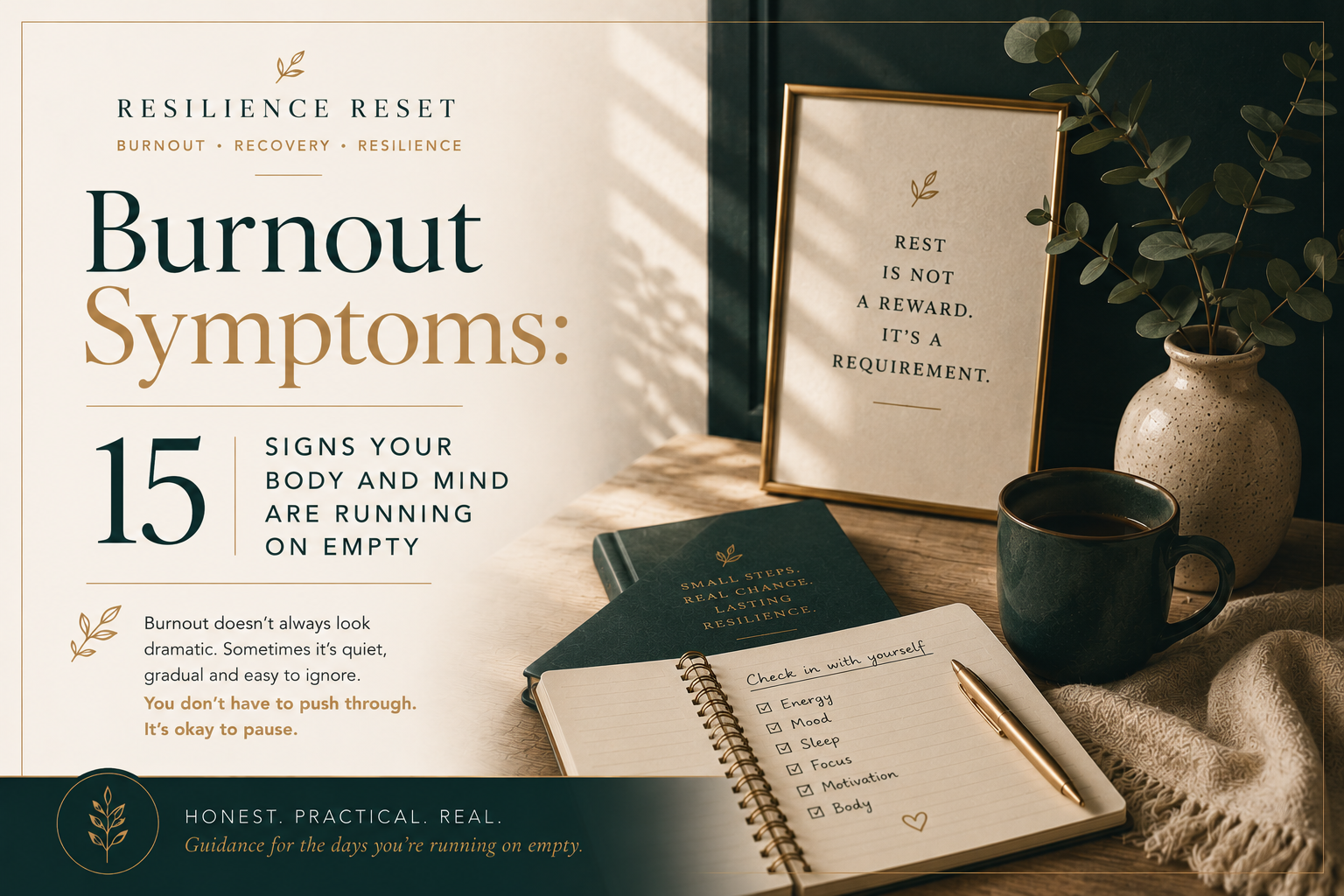
Burnout Symptoms: 15 Signs Your Body and Mind Are Running on Empty
Burnout does not always look like falling apart. Sometimes it looks like carrying on, answering the messages, meeting the deadlines and doing what needs to be done while quietly wondering how much longer you can keep going.
You can still be functioning and be exhausted. You can still turn up for work, care for other people, keep the house moving and appear completely capable from the outside while feeling as though there is almost nothing left inside the tank.
That is part of what can make burnout difficult to recognise. We often imagine burnout as a dramatic breaking point. In reality, the warning signs may begin much earlier. Your patience gets shorter. Concentrating becomes harder. Things you once managed automatically begin to feel disproportionately difficult. Rest stops feeling restorative.
And because life does not necessarily stop when your capacity starts disappearing, it is very easy to keep adapting around the exhaustion rather than recognising what it may be telling you.
- persistent physical or emotional exhaustion
- difficulty concentrating and making decisions
- irritability or feeling emotionally overwhelmed
- loss of motivation
- withdrawing from people
- feeling detached or cynical about work
- sleep problems
- feeling less effective despite trying harder
What is burnout?
The word burnout is used widely to describe a state of deep physical, mental and emotional exhaustion after prolonged pressure.
There is, however, an important distinction worth understanding. The World Health Organization defines burnout specifically as an occupational phenomenon resulting from chronic workplace stress that has not been successfully managed.
Its definition centres on three areas: exhaustion, increasing mental distance or negativity towards work, and reduced professional effectiveness.
In everyday conversation, people often use the word more broadly when prolonged demands from work, caring responsibilities, relationships, financial pressure or life circumstances leave them feeling depleted. This article discusses those wider experiences while being clear that persistent exhaustion can also have other causes.
Important: feeling exhausted does not automatically mean you have burnout. Persistent tiredness can also be linked to sleep problems, stress, depression, anaemia, thyroid conditions and other health issues. If your tiredness is persistent, unexplained or affecting daily life, speak to a healthcare professional.
15 common signs you may be running on empty
No single symptom proves that you are experiencing burnout. What matters more is the overall pattern, particularly when several changes appear together and continue over time.
You feel tired even after resting
This is more than feeling sleepy after a late night. You may wake up already feeling depleted or find that a weekend, evening off or early night does not restore you in the way it once did.
It can begin to feel as though you are constantly borrowing energy from tomorrow simply to make it through today.
Your concentration has become unreliable
You reread the same paragraph. You forget why you walked into a room. You open an email and struggle to formulate a response that would normally take seconds.
Long periods of stress can make concentration and decision making feel noticeably harder. What looks from the outside like disorganisation may actually be a sign that your mental capacity is overloaded.
Small things suddenly feel enormous
A normal request can feel like one demand too many. A change of plan may feel unbearable. Even deciding what to cook can become another decision you do not have the capacity to make.
It does not necessarily mean the task itself has become harder. Your available capacity may simply have become smaller.
You are becoming more irritable
You may notice yourself snapping more quickly, losing patience with people you care about or feeling disproportionately frustrated by interruptions.
That can create guilt afterwards, particularly if irritability does not feel like you. But when there is little emotional bandwidth left, your tolerance for additional pressure can fall sharply.
You have stopped looking forward to things
The activities that usually give you pleasure can begin to feel like additional commitments. Meeting friends, exercising, cooking, hobbies or even watching something you enjoy may feel like effort.
Your world can gradually become organised around getting through obligations rather than experiencing anything restorative.
You are withdrawing from people
Messages go unanswered. Invitations are declined. You may tell yourself you simply need space, yet increasingly find yourself pulling away from connection.
Sometimes this happens because conversation itself requires energy. Sometimes it is because explaining how exhausted you feel seems harder than saying nothing.
Your motivation has disappeared
This can be particularly confusing when you have always thought of yourself as motivated, ambitious or dependable.
Suddenly forcing yourself to begin even familiar tasks can require enormous effort. You might interpret this as laziness or lack of discipline when your capacity may simply be heavily depleted.
You feel emotionally numb
Burnout is not always intense emotion. Sometimes it is the absence of it.
You may stop feeling excited about successes, feel detached from things that used to matter or describe yourself as simply going through the motions.
Your sleep is changing
You might be exhausted all day and then find your brain suddenly becomes active the moment your head reaches the pillow.
Other people begin sleeping much more than usual but still wake feeling unrefreshed. Stress can affect sleep in different ways, so the important thing is recognising a meaningful change from what is normal for you.
You feel increasingly cynical about work
This is particularly relevant to occupational burnout. Work that once felt meaningful can begin to feel pointless, frustrating or emotionally distant.
You may find yourself caring less, feeling resentful or mentally disconnecting simply to get through the working day.
You are working harder but achieving less
One of the cruellest parts of prolonged exhaustion is that people often respond by pushing themselves harder.
You stay later. Try harder. Skip breaks. Work through lunch. Yet tasks take longer and mistakes become more likely. The answer can appear to be even more effort when what you may actually need is recovery and reduced demand.
You cannot properly switch off
Your body may have stopped working but your mind has not. You replay conversations, think about tomorrow’s workload or feel guilty when you are not doing something productive.
Rest then becomes physically possible without feeling psychologically available.
You are relying on coping habits more heavily
You may notice yourself leaning more on scrolling, alcohol, comfort eating, caffeine, shopping, avoidance or anything else that gives you temporary relief from how overwhelmed you feel.
It is worth becoming curious about these changes rather than immediately judging yourself for them. Coping behaviours often tell us something about what we are trying to escape, soothe or survive.
Your body seems to be carrying the pressure
Stress can have physical effects as well as emotional ones. Some people notice headaches, muscle tension, digestive changes, altered appetite or a constant sense of being physically on edge.
Physical symptoms should not automatically be attributed to burnout, particularly if they are new, severe or persistent. Speak to a healthcare professional if you are concerned.
You keep telling yourself to just get through this week
Then next week arrives.
And there is another deadline, another crisis, another responsibility or another reason recovery needs to wait.
This is one of the patterns worth paying particular attention to: when survival mode stops being temporary and quietly becomes your normal way of living.
A moment of reflection
Instead of asking only, “Can I keep going?”, try asking:
“What is it costing me to keep going in exactly the same way?”
Being capable of carrying something does not automatically mean carrying it indefinitely is sustainable.
Burnout or just tired?
Ordinary tiredness usually has an identifiable cause and tends to improve after sufficient rest.
With prolonged exhaustion, the situation can feel different. Rest may help temporarily without addressing the demands that are draining you. Emotional changes can appear alongside the tiredness, including irritability, disconnection, reduced motivation and difficulty thinking clearly.
This is why simply telling someone experiencing severe exhaustion to “get more sleep” may not address the bigger problem.
You may need to look not only at how much rest you are getting, but also at what keeps taking more from you than you are able to restore.
Why does burnout sometimes seem to appear suddenly?
Often, it has not appeared suddenly at all.
What feels like the moment you “hit the wall” may be the point at which a much longer period of overextension finally becomes impossible to ignore.
Human beings are extremely good at adapting. We normalise poor sleep. We drink another coffee. We stop doing the things that are not urgent. We work through lunch. We cancel plans. We tell ourselves things will calm down soon.
Each individual adjustment can seem insignificant. Together, however, they can gradually shrink life until almost all available energy is being used simply to keep functioning.
Can you have burnout and still be functioning?
Yes. Continuing to function does not necessarily mean the current pattern is sustainable.
Some people remain highly productive for a considerable period while experiencing severe exhaustion. They may continue working, parenting, caregiving and meeting responsibilities while privately struggling.
That can be particularly common in people who are accustomed to being the reliable person, the problem solver or the one who keeps going when life becomes difficult.
Functioning should therefore not be the only measure you use when deciding whether something needs to change.
What should you do if these burnout symptoms feel familiar?
Recovery does not need to begin with a dramatic life overhaul. When you are already depleted, adding an enormous self improvement plan can simply become another source of pressure.
Start smaller.
When should you speak to a GP?
It is sensible to seek medical advice if tiredness has continued for weeks, you cannot explain why you are tired, it is affecting your daily life or you have other symptoms that concern you.
Fatigue can have many causes. Stress is one possibility, but it is not the only one. Getting appropriate advice can help rule out other explanations rather than assuming everything you are experiencing is burnout.
If your mental health is deteriorating significantly, you are struggling to cope, or you feel unsafe, seek professional or urgent support rather than relying on online information alone.
Burnout recovery is not about becoming better at tolerating exhaustion
This is one of the most important things I want you to take from this article.
Resilience is not the ability to absorb unlimited pressure.
Sometimes resilience means recognising that the way you are living, working or carrying responsibility needs to change.
The goal should not always be to become better at surviving conditions that are repeatedly draining you.
It can be learning to notice your limits sooner. Protecting your energy before it disappears. Asking for support before you reach breaking point. Changing expectations that were never realistic in the first place.
You do not need to wait until you are completely unable to function before your exhaustion deserves attention.
Sometimes the most useful question is not: “How do I push through this?”
It is: “What needs to change so I don’t have to keep living like this?”
If you recognise yourself in this, start with your capacity.
The Burnout Reset Guide is a practical guide to understanding what is draining your energy, recognising the patterns that keep you running on empty, protecting your capacity and making realistic changes without adding more pressure.
Explore the Burnout Reset GuideSources and further reading
- World Health Organization: Burn-out as an occupational phenomenon
- NHS Every Mind Matters: Work-related stress
- NHS Every Mind Matters: Stress
- NHS: Tiredness and fatigue
Medical disclaimer: Resilience Reset provides educational information and practical wellbeing guidance. It is not a substitute for diagnosis, medical advice, treatment or professional mental health support. If you are concerned about persistent tiredness, physical symptoms or your mental health, speak to an appropriate healthcare professional.