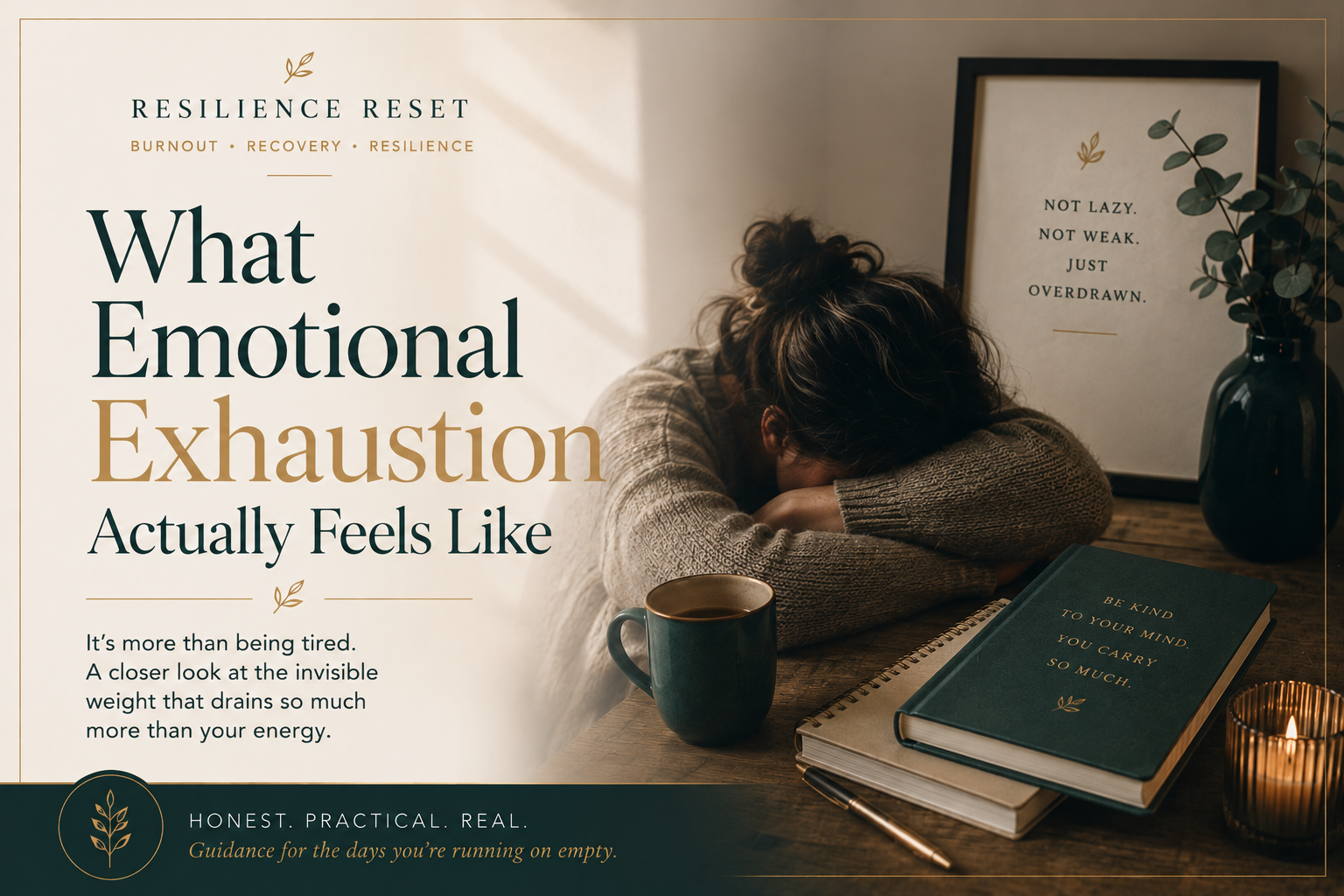
What Emotional Exhaustion Actually Feels Like
What Emotional Exhaustion Actually Feels Like
Feeling detached, flat or easily overwhelmed can be difficult to make sense of. This article explores what emotional exhaustion can feel like and when it may be time to seek extra support.
Emotional exhaustion does not always look dramatic.
Sometimes it looks like staring at a message because you do not have the energy to reply.
Or somebody tells you something exciting and you know you should feel happy, but you just feel… flat.
You are not necessarily crying. You have not completely fallen apart. You just do not feel like yourself.
What is emotional exhaustion?
Emotional exhaustion is a term often used to describe feeling emotionally drained after prolonged periods of pressure or demanding circumstances.
It can be associated with burnout, although feeling emotionally exhausted does not automatically mean you have burnout.
What matters is recognising when something has changed.
Everything feels like another demand
Someone asks a perfectly reasonable question.
Your immediate thought is: Please do not ask me for anything else.
It is not necessarily about them. You may simply feel as though your capacity has disappeared.
You feel detached
You might find yourself withdrawing from conversations, work or activities you usually enjoy.
You stop initiating plans. You answer messages with the minimum required response.
You are not deliberately pushing people away. Engaging just feels like effort.
Small things overwhelm you
When your capacity is already stretched, tiny problems can feel enormous.
The dishwasher breaks. You cannot find your keys. Someone changes a meeting.
Suddenly, you want to scream or cry.
It may not be about the keys. It may be about everything else you are carrying.
You feel guilty for not being yourself
This can make emotional exhaustion even harder.
You know you are irritable. You know you are withdrawing. You know you are not showing up like you normally would.
So you start criticising yourself.
But criticism rarely creates more capacity. Curiosity is often more useful.
Ask:
- What has been happening lately?
- What am I carrying?
- When did I start feeling like this?
- What support might make things easier?
Burnout recovery begins with noticing
You do not have to wait until you have reached breaking point before taking exhaustion seriously.
Start with what you can change. Reduce unnecessary demands where possible. Protect some of your time. Talk to someone you trust. Look at the boundaries you have lost along the way.
And if emotional exhaustion is persistent, severe, affecting everyday life or you are concerned about how you feel, consider speaking with a qualified healthcare professional.
Resilience does not mean pretending everything is fine.
Sometimes resilience begins with being honest enough to say: I’m exhausted, and something needs to change.