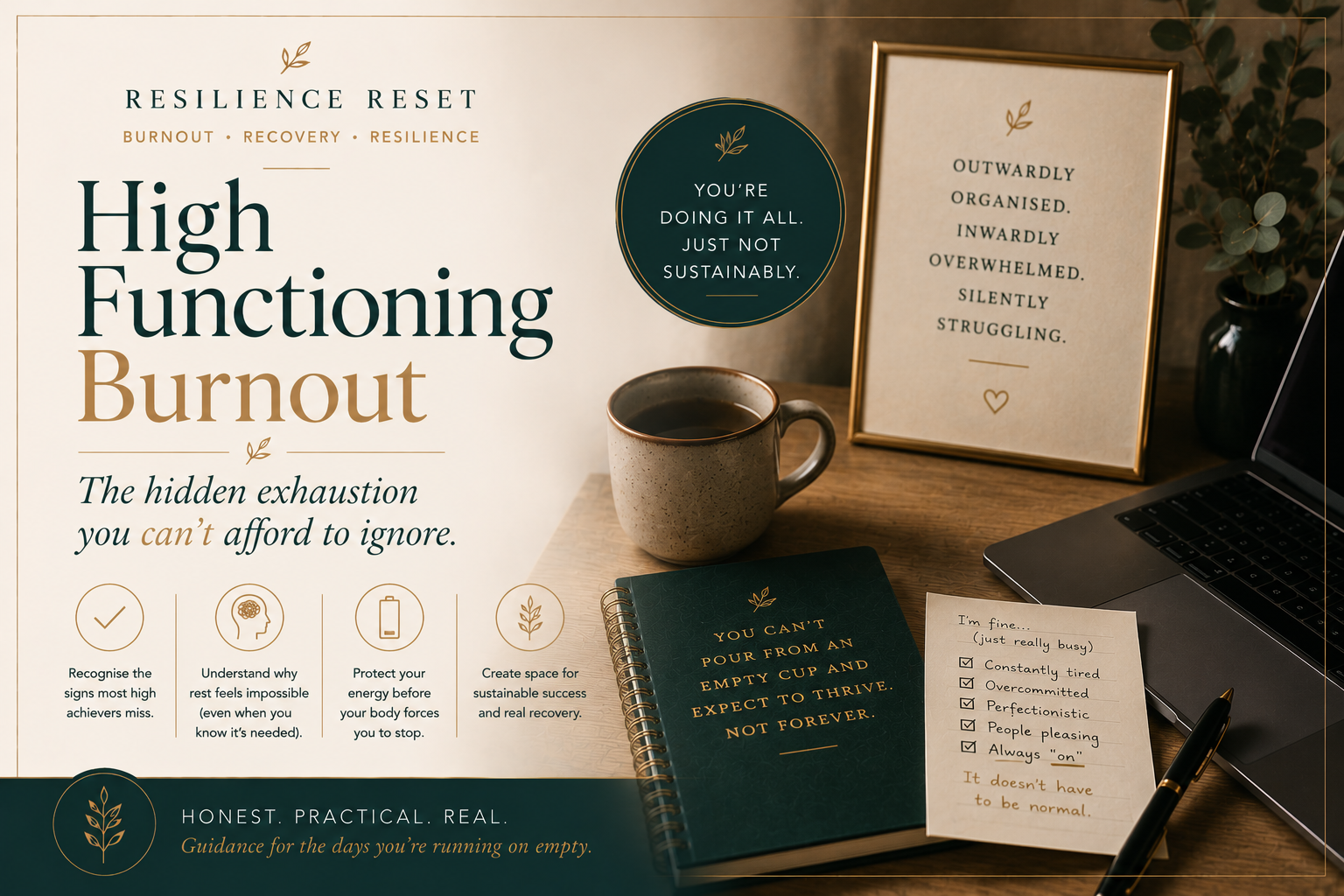
High Functioning Burnout: When You Look Fine but Feel Completely Exhausted
High Functioning Burnout: When You Look Fine but Feel Completely Exhausted
You are still getting things done. You still answer the emails, show up for work and take care of what needs to be done. From the outside, you may look completely fine. Inside, however, you are wondering how much longer you can keep functioning at this pace.
Burnout does not always announce itself with a dramatic breakdown.
Sometimes it looks remarkably ordinary.
You get out of bed. You go to work. You complete your responsibilities. Perhaps people even describe you as organised, dependable or successful.
Meanwhile, almost everything behind that functioning is becoming harder.
You are exhausted when you wake up. Small decisions feel heavy. Your patience is disappearing. You have little energy left for yourself once everybody else has received what they need.
Nevertheless, because you are still functioning, you convince yourself that things cannot be that bad.
This is often what people mean when they talk about high functioning burnout.
“High functioning burnout” is not a separate medical diagnosis. Instead, the phrase is commonly used to describe someone who continues to perform, work and meet responsibilities while experiencing significant exhaustion, stress or reduced emotional capacity behind the scenes.
In other words, visible productivity can hide an increasingly unsustainable level of pressure.
Can you be burned out and still function?
Yes. A person does not need to become completely unable to work before prolonged stress deserves attention.
In fact, some people can maintain a high level of performance for a surprisingly long time.
However, functioning and coping are not necessarily the same thing.
You may still complete the task while using far more energy than it once required. You may still attend the meeting while feeling mentally absent. You may still care for everybody else while having almost nothing left for yourself.
Therefore, the question is not simply whether you can keep going.
A more useful question may be whether continuing in the same way is sustainable.
Why high functioning burnout can be difficult to recognise
We tend to judge wellbeing by what we can see.
If somebody is still working, smiling, meeting deadlines and taking care of their responsibilities, we often assume they are coping well.
Unfortunately, that assumption can also influence how we judge ourselves.
You may think:
“I’m still getting everything done, so I must be fine.”
However, what nobody sees is the recovery required after every ordinary task.
They may not see you lying on the sofa unable to speak after work. They do not see the messages you cannot bring yourself to answer. They do not see you staring at an email because your brain cannot form a reply.
As a result, your outward performance can hide your declining capacity even from you.
10 signs of high functioning burnout
There is no official checklist for “high functioning burnout.” Nevertheless, there are several patterns worth noticing when high performance and deep exhaustion begin appearing together.
You are still productive, but everything takes more effort
You continue delivering what people expect. However, work that once felt straightforward now requires considerably more concentration and energy.
You may need longer to complete tasks. Alternatively, you may rely on pressure and last minute urgency to force yourself through them.
You collapse when nobody needs anything from you
During the working day, you keep moving. Then you arrive home and have nothing left.
You may sit in silence, scroll for hours or avoid conversation because even simple interaction feels like another demand.
Therefore, the exhaustion becomes visible only when the performance stops.
You need pressure to get things done
Motivation may have disappeared. As a result, urgency becomes the thing that keeps you functioning.
You wait until the deadline is close. Then adrenaline carries you through. Afterwards, however, you feel completely depleted.
You have become more irritable
Your tolerance for interruptions may become much lower.
Small requests feel bigger. Noise bothers you more. You may become impatient with people you genuinely care about.
NHS guidance notes that stress can affect mood and behaviour, including irritability and feeling overwhelmed.
You cannot switch off after work
You finish working physically but continue working mentally.
You replay conversations, think about unfinished tasks or check tomorrow’s schedule repeatedly.
Consequently, your recovery time never feels completely separate from your work.
Your personal life receives whatever energy is left
You use most of your available capacity performing professionally.
Therefore, friends, hobbies, exercise, cooking and ordinary life may gradually disappear from your evenings.
Your life becomes increasingly organised around recovering enough to work again.
You feel guilty when you are not being productive
Rest may feel uncomfortable rather than restorative.
Perhaps you sit down and immediately notice what else you could be doing. As a result, even your downtime can become mentally demanding.
You may also feel that resting has to be earned.
You keep telling yourself that things will calm down soon
You only need to survive this deadline.
Then this project.
Then this particularly busy month.
However, the quieter period never actually arrives.
Consequently, survival mode becomes a permanent working pattern rather than a temporary response to an unusually demanding period.
You have become emotionally detached from work
Perhaps you once cared deeply about what you did.
Now you may find yourself thinking, “I just don’t care anymore.”
This matters because WHO’s definition of occupational burnout includes increasing mental distance from work or feelings of negativity or cynicism towards it.
Everybody thinks you are coping better than you are
People may tell you that you always have everything together.
Ironically, being seen as capable can make it harder to admit when you are struggling.
You may think asking for help will disappoint people or challenge the version of you they rely on.
Therefore, you keep carrying more.
Functioning is not the same as flourishing
Ask yourself:
“If nobody could see how much I am achieving, would I still describe the way I feel as coping well?”
Sometimes we measure our wellbeing by our output rather than by our actual experience of life.
Why capable people can miss burnout for longer
Being resourceful is valuable.
However, it can also make it easier to compensate when your capacity begins declining.
You become more organised.
You work later.
You stop doing things that are not urgent.
You use weekends to recover.
You drink another coffee.
You cancel plans.
At first, these adjustments keep everything moving.
Eventually, however, there may be very little left to remove except the things that support your wellbeing.
Therefore, one of the dangers of always being “the capable one” is that your ability to adapt can hide the fact that your circumstances need to change.
High functioning burnout and perfectionism
Perfectionism can make exhaustion particularly difficult to acknowledge.
You may believe that reducing your standards means you are becoming lazy.
Perhaps asking for help feels like failure.
Alternatively, you may feel responsible for preventing anything from going wrong.
As a result, instead of reducing demands when your energy falls, you increase your effort.
This can create a difficult pattern:
Your capacity falls, so you work harder.
Because you work harder, your capacity falls further.
Then you judge yourself for struggling and increase the pressure again.
Breaking that cycle may require changing the standard, not simply finding more energy.
High functioning burnout at work
Workplaces often reward output.
Therefore, early burnout can remain almost invisible if performance has not yet declined significantly.
A person may still meet targets while working late every evening.
They may still deliver excellent work while barely sleeping.
They may still appear calm in meetings while privately feeling overwhelmed.
However, maintaining performance through constant overextension is not the same as having sustainable capacity.
WHO describes burnout as an occupational phenomenon linked to chronic workplace stress that has not been successfully managed. Its definition includes exhaustion, increased mental distance or cynicism towards work and reduced professional efficacy.
A useful distinction: “High functioning burnout” is not an official WHO diagnostic category. It is a descriptive phrase commonly used for the experience of continuing to perform while feeling significantly depleted.
Why weekends stop feeling long enough
Friday evening arrives and you feel relieved.
Saturday may disappear recovering.
Then Sunday becomes preparation for Monday.
Consequently, the weekend no longer feels like part of your life. It becomes maintenance time that allows you to function for another working week.
This can be an important signal.
Rest should not need to repair the entire impact of your working life every seven days.
Why you might feel exhausted after doing almost nothing
When your capacity is depleted, ordinary tasks can require disproportionately large amounts of energy.
Therefore, an evening spent doing “nothing” does not necessarily mean your body and mind have not been working hard.
You may still be processing stress, worrying about tomorrow or recovering from the effort required to function throughout the day.
If persistent exhaustion is becoming a major part of your life, read Why Am I So Tired All the Time? Understanding Deep Fatigue .
High functioning burnout vs ordinary stress
Stress often involves feeling that there is too much to deal with.
However, prolonged exhaustion may begin to feel more like having too little left with which to deal with it.
You may notice less motivation, less emotional capacity and a growing sense of detachment.
For a fuller comparison, read Burnout vs Stress: What’s the Difference When You’re Exhausted? .
What happens if you keep pushing through burnout?
People often respond to reduced capacity by increasing effort.
At first, this may appear to work.
However, it can become increasingly difficult to maintain the same output.
You may notice more mistakes, slower thinking or greater irritability.
In addition, your sleep and relationships may begin to suffer.
Eventually, you may reach a point where the strategies that previously kept you functioning stop working.
Therefore, recognising exhaustion before complete collapse is not weakness.
It is useful information.
How do you recover from high functioning burnout?
Recovery does not necessarily begin with quitting your job, cancelling your entire life or disappearing for several months.
Instead, start by reducing the gap between what you are carrying and what you actually have capacity for.
Why doing less can feel so uncomfortable
If your identity has become connected to being dependable, reducing your output can feel threatening.
Perhaps people rely on you.
Perhaps you rely on being needed.
Therefore, the idea of doing less may create guilt long before it creates relief.
However, boundaries are not a sign that you have stopped caring.
They are one way of making sure that caring does not repeatedly cost you more than you can sustainably give.
If this feels familiar, read How to Set Boundaries Without Feeling Guilty .
Can you recover while still working?
For many people, taking a long period away from work is not realistic.
Fortunately, recovery is not always an all or nothing process.
However, continuing to work may require changing how you work.
For example, you may need clearer priorities, protected breaks or reduced availability outside working hours.
You may also need a conversation about workload or reasonable adjustments where appropriate.
Read: Can You Recover From Burnout While Still Working?
How long does recovery take?
There is no fixed burnout recovery timeline.
Some people begin feeling noticeably better relatively quickly after pressure reduces.
Others may need considerably longer, particularly if exhaustion has been building for a long time or the original stressors remain.
Therefore, try not to turn recovery itself into another deadline.
You can explore this further in How Long Does Burnout Recovery Take? What Recovery Actually Looks Like .
When should you speak to a GP?
Persistent exhaustion should not automatically be labelled burnout.
Fatigue can have many possible causes. Therefore, medical advice can be important when tiredness continues without an obvious explanation.
NHS guidance recommends speaking to a GP if you have been tired for several weeks and do not know why, if tiredness is affecting daily life or if it occurs alongside other symptoms. :contentReference[oaicite:1]{index=1}
Likewise, seek professional support if changes in mood, sleep, anxiety or your ability to cope are causing concern.
You do not have to collapse before something needs to change
Perhaps this is the most important part.
You do not have to wait until you cannot get out of bed.
You do not have to wait until your work begins falling apart.
You do not have to wait until everybody else finally notices that you are struggling.
Being able to continue does not mean continuing is cost free.
Therefore, instead of asking:
“Am I bad enough to need to slow down?”
Try asking:
“What is this way of functioning costing me?”
Perhaps it is your sleep.
Perhaps it is your patience.
Perhaps it is your relationships.
Perhaps it is the ability to enjoy any part of your life that does not involve being productive.
Most importantly, do not mistake your ability to endure something for evidence that it is sustainable.
Real resilience is not about proving how much pressure you can survive.
Sometimes it begins with recognising that you no longer want survival mode to become your normal.
You do not need to wait for a breaking point to protect your capacity.
The Burnout Reset Guide helps you understand what is draining your energy, recognise the patterns keeping you in survival mode, strengthen your boundaries and make realistic changes without adding more pressure.
Explore the Burnout Reset GuideSources and further reading
- World Health Organization: Burn-out as an occupational phenomenon
- NHS Every Mind Matters: Stress
- NHS: Get help with stress
- NHS: Tiredness and fatigue