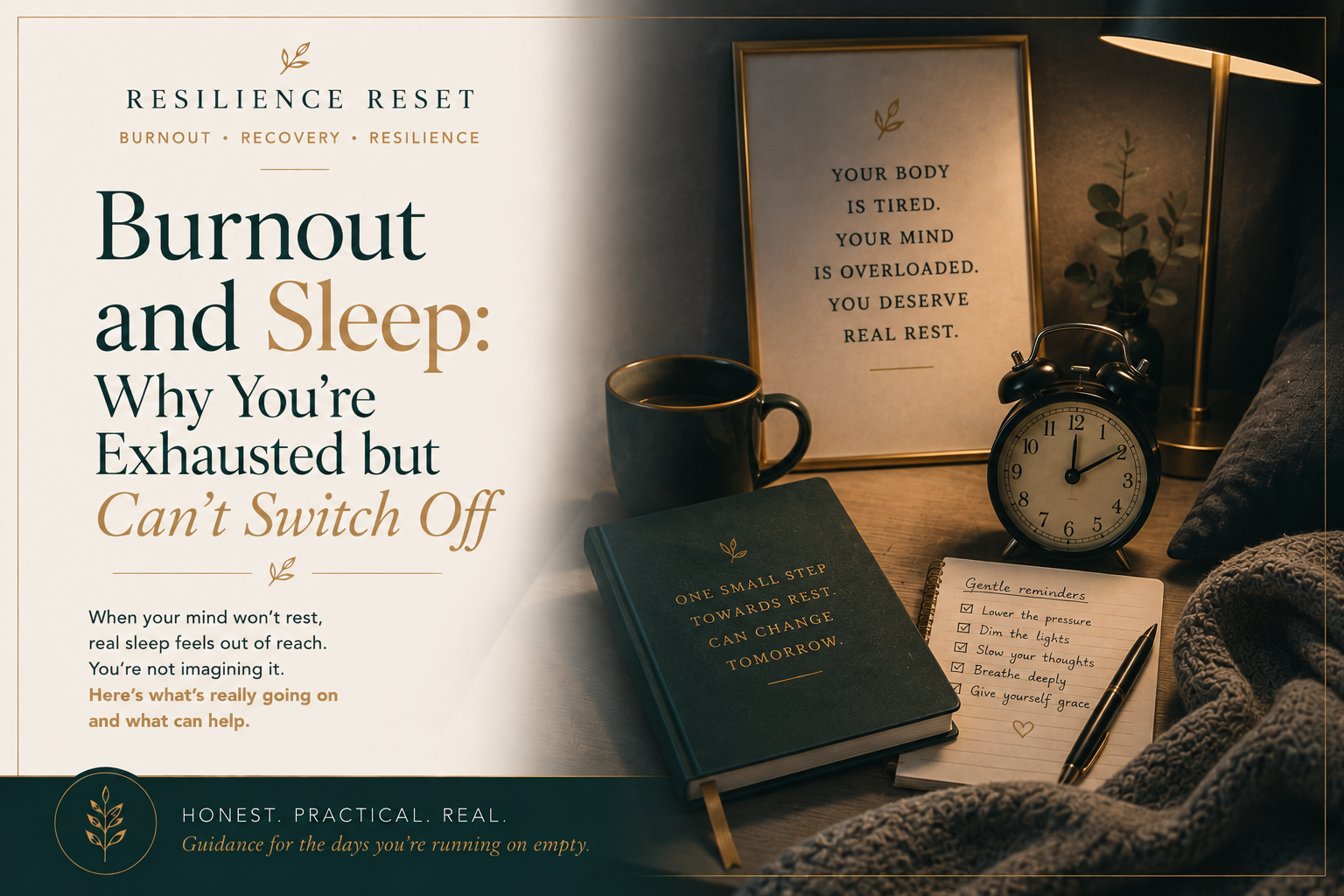
Burnout and Sleep: Why You’re Exhausted but Still Can’t Switch Off.
Burnout and Sleep: Why You’re Exhausted but Still Can’t Switch Off
You have spent the whole day wishing you could crawl into bed. Yet, when bedtime finally arrives, your body is exhausted and your mind suddenly wants to replay everything that happened today, tomorrow and three years ago. If that sounds familiar, prolonged stress may be affecting more than your energy.
There is a particularly frustrating kind of exhaustion where you desperately need rest but cannot seem to settle into it.
During the day, you may struggle to concentrate. Your eyes feel heavy. Your motivation disappears. Therefore, you assume sleep will come easily.
Then you get into bed.
Suddenly, your mind becomes busy. You remember an email you forgot to send. You start thinking about tomorrow. Perhaps you replay a conversation or begin planning how you will catch up with everything you did not finish.
As a result, you can feel both exhausted and unable to switch off at exactly the same time.
Burnout, prolonged workplace stress and sleep problems can overlap. Stress can make it harder to relax, while poor sleep can leave you with less energy and emotional capacity to deal with pressure the following day. Consequently, a difficult cycle can develop: stress disrupts sleep, poor sleep increases exhaustion and exhaustion makes everyday demands feel harder.
Why am I exhausted but unable to sleep?
Feeling physically tired does not automatically mean your mind is ready to switch off.
When life has been demanding for a long time, you may spend much of the day focused on completing tasks, solving problems and responding to other people.
However, bedtime removes many of those distractions.
For the first time all day, there may be nothing demanding your immediate attention. Therefore, thoughts you have been pushing aside can suddenly become much louder.
You may begin thinking about work, money, relationships, unfinished tasks or everything waiting for you tomorrow.
In other words, your body has stopped for the day, but your mind may still be working through everything it has been carrying.
What does burnout related sleep trouble feel like?
Sleep difficulties do not look the same for everybody. Nevertheless, there are several patterns people commonly describe when they are under prolonged pressure.
You feel exhausted all day but more awake at night
You may spend the afternoon thinking about bed. However, once you finally have permission to stop, you suddenly feel more alert.
Sometimes this happens because evening becomes the only part of the day that feels like your own.
You cannot stop thinking about tomorrow
Your mind starts preparing for the next working day before the current one has properly ended.
For example, you may mentally rehearse meetings, remember unfinished tasks or worry about how much you need to achieve.
You wake during the night thinking about work
Perhaps you fall asleep easily but wake at 2am or 4am with your mind already running through problems.
As a result, even several hours in bed may not feel particularly restorative.
You sleep for longer but still wake exhausted
Not every sleep problem involves too little sleep. Sometimes you may sleep more than usual and still wake feeling depleted.
Persistent unexplained tiredness deserves medical attention because fatigue has many possible causes. Therefore, do not automatically assume burnout is the explanation.
You delay bedtime even though you are tired
You know you should sleep. Instead, you scroll, watch another episode or keep finding small things to do.
This may appear irrational. However, if the evening is the only time that feels free from demands, going to sleep can feel like giving that freedom away and moving straight into tomorrow.
The burnout and sleep cycle
One reason sleep deserves attention during burnout recovery is that stress and sleep can begin reinforcing each other.
First, pressure makes it harder to switch off.
Then poor sleep leaves you with less energy the next day.
As a result, tasks take longer and concentration becomes harder. You may also feel more irritable or emotionally overwhelmed.
Consequently, work can start accumulating.
You stay later or work harder to compensate. Therefore, there is even less time available for genuine recovery.
Then bedtime arrives and your mind is still processing the day.
The cycle begins again.
Look beyond the bedtime problem
If you cannot switch off at night, it is worth asking more than: “How can I make myself sleep?”
Also ask:
“What am I carrying through the day that my mind is still trying to process when everything finally becomes quiet?”
Sometimes improving sleep requires looking at the pressure surrounding sleep, not only the hours spent in bed.
Is poor sleep a symptom of burnout?
Sleep problems can occur alongside prolonged stress and burnout. However, they are not proof that somebody has burnout.
The World Health Organization describes burnout specifically as an occupational phenomenon associated with chronic workplace stress that has not been successfully managed.
The WHO definition focuses on exhaustion, increased mental distance or negativity towards work and reduced professional effectiveness.
Meanwhile, sleep difficulties have many possible causes. These include stress, anxiety, lifestyle factors, health conditions, medication and sleep disorders.
Therefore, it is important not to diagnose yourself based on one symptom.
Why sleeping more may not completely fix burnout
Sleep matters. However, sleep alone cannot necessarily solve an unsustainable situation.
Imagine charging your phone to 30 percent every night while using 80 percent of its battery every day.
Eventually, the maths stops working.
Burnout recovery can be similar.
If your daily demands consistently require more energy than you can restore, simply trying to optimise your sleep may not address the underlying imbalance.
Therefore, recovery often requires two things at once: restoring energy and reducing unnecessary demand.
Why you might be waking up already exhausted
Waking tired occasionally is normal. However, repeatedly waking exhausted can feel deeply discouraging.
You may start each day already feeling behind.
Then ordinary responsibilities require more effort. Consequently, you use more of your limited energy simply keeping up.
By evening, you are depleted again.
If this pattern continues, read Why Am I So Tired All the Time? Understanding Deep Fatigue .
Most importantly, persistent unexplained fatigue should be discussed with a healthcare professional because there are many possible causes beyond stress.
Why does my brain become active as soon as I get into bed?
During a busy day, your attention is constantly being redirected.
There are emails, conversations, responsibilities, notifications and decisions. Therefore, there may be very little mental space available for reflection.
Bedtime changes that.
The room becomes quieter. Your phone may finally stop ringing. Nobody needs an immediate answer.
As a result, your mind finally has space to notice what has been pushed aside.
That does not mean you are deliberately keeping yourself awake.
Instead, your brain may simply be trying to process unfinished thoughts at the first quiet opportunity it has had all day.
Can burnout make you want to sleep all the time?
Some people experience difficulty sleeping. Others feel as though they could sleep constantly.
Therefore, it is important not to imagine one universal burnout sleep pattern.
You might want naps throughout the day. Perhaps getting out of bed feels increasingly difficult. Alternatively, you may sleep for long periods without feeling refreshed.
However, excessive tiredness should not automatically be labelled burnout.
If your tiredness has continued for several weeks, is affecting your daily life or has no obvious explanation, NHS guidance recommends speaking to a GP.
How to support sleep when you are burned out
When you are already exhausted, the last thing you need is a complicated 12 step night routine that becomes another thing to fail at.
Instead, start with changes that reduce pressure.
Stop turning sleep into another thing you have to succeed at
This matters more than it might seem.
When you desperately need sleep, it is easy to become anxious about not getting enough.
You check the time.
Then you calculate how many hours remain before your alarm.
Next, you start worrying about how exhausted you will be tomorrow.
Consequently, bedtime becomes another place where you feel under pressure.
Instead, try to think about creating conditions that support rest rather than forcing yourself to sleep on command.
What should you do when your mind will not switch off?
If thoughts keep circling, fighting them may not always help.
Instead, give them somewhere to go.
For example, keep a notebook nearby and write down the task, worry or reminder that keeps returning.
Then ask yourself whether anything genuinely needs to be solved tonight.
Usually, the answer is no.
Therefore, the aim is not necessarily to solve every thought. It is to stop asking your mind to hold all of them until morning.
Could your boundaries be affecting your sleep?
If work follows you into every part of your evening, your mind receives very few signals that the working day has ended.
For example, perhaps you check messages during dinner. Then you respond to an email from the sofa. Finally, you check tomorrow’s calendar from bed.
Technically, you stopped working hours ago.
Mentally, however, you may never have left.
Creating clearer boundaries around availability can therefore support recovery.
If saying no or switching off creates guilt, read How to Set Boundaries Without Feeling Guilty .
What if I still have to work while recovering?
Many people cannot simply disappear from work for several months.
Fortunately, recovery is not always an all or nothing decision.
Small changes can still matter.
For instance, you may be able to protect your lunch break, reduce unnecessary after hours contact or discuss workload with your manager.
You may also need to become more selective about what receives your energy outside work.
For more guidance, read Can You Recover From Burnout While Still Working? .
How long does sleep take to improve during burnout recovery?
There is no universal timeline.
Some people notice changes relatively quickly once immediate pressure reduces. For others, sleep difficulties may continue for longer.
In addition, recovery is rarely perfectly linear. You might sleep well for several nights and then struggle again during a particularly demanding week.
Therefore, try to look at the overall pattern rather than judging recovery based on one difficult night.
You can explore this further in How Long Does Burnout Recovery Take? .
When should you speak to a GP about sleep and exhaustion?
Do not assume persistent exhaustion is simply something you need to push through.
Consider speaking to a GP if you have had difficulty sleeping for months, changes to your sleep are affecting daily life or persistent tiredness has continued for weeks without a clear explanation.
Likewise, seek professional advice if you have other physical or mental health symptoms that concern you.
There may be several possible explanations. Therefore, getting appropriate advice is more useful than automatically labelling every symptom as burnout.
Important: Burnout is not the only explanation for exhaustion or sleep problems. Persistent fatigue and significant sleep changes can have physical and psychological causes. Speak to an appropriate healthcare professional if you are concerned.
Burnout recovery is about more than getting eight hours
Sleep is important. Nevertheless, recovery is bigger than bedtime.
If you spend every waking hour exceeding your capacity, even excellent sleep may struggle to compensate for the pressure.
Therefore, ask yourself what happens before you get into bed.
How much of your day belongs to other people’s demands?
When do you stop working mentally, not just physically?
Where are your boundaries being crossed?
What are you continuing to carry because you believe you should be able to handle it?
Most importantly, what could become lighter?
You do not necessarily need to become better at pushing through exhaustion.
You may need to create a life that gives your body and mind more opportunities to recover before they reach empty.
Start by understanding what is draining your capacity.
The Burnout Reset Guide is a practical guide to recognising burnout patterns, protecting your energy, strengthening your boundaries and making realistic changes without turning recovery into another overwhelming task.
Explore the Burnout Reset GuideSources and further reading
For further evidence based information, see guidance from the World Health Organization on occupational burnout and NHS information about insomnia, tiredness, fatigue and stress.
- World Health Organization: Burn-out as an occupational phenomenon
- NHS: Insomnia
- NHS: Tiredness and fatigue
- NHS Every Mind Matters: Stress